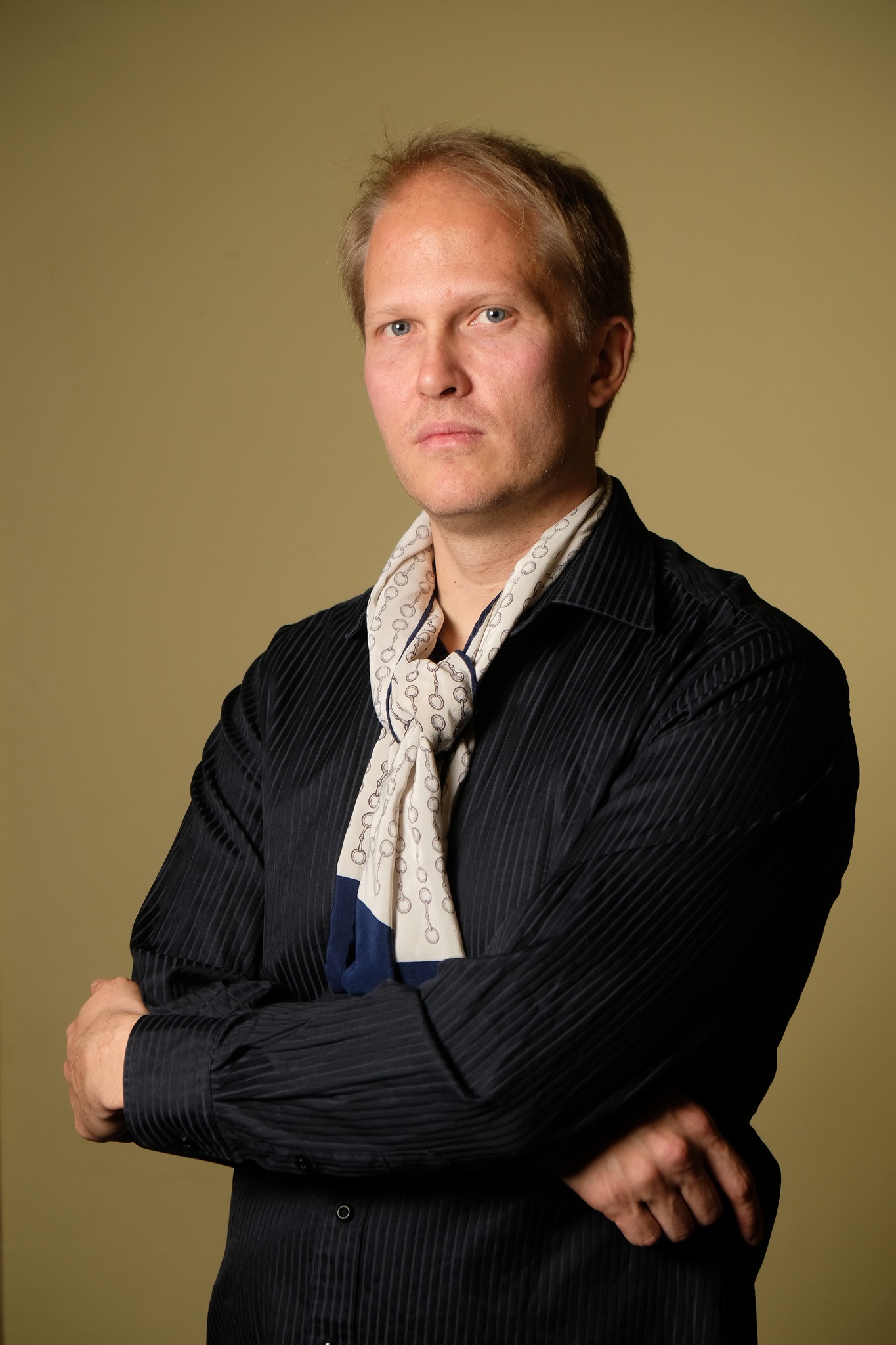
founder and chief conductor
Timo Tuhkanen
Working at the intersection of sound, touch, and speculative musical futures, Timo S. Tuhkanen emerges as a conductor redefining what an orchestra can be. As the founder of the Microtonal Orchestra, Tuhkanen is currently shaping what may become the world’s first fully realized microtonal orchestra—an ensemble conceived not only as a performing body, but as a living research environment for new musical languages, instrumental systems, and collective practices.
Born in Muscat in 1983, Tuhkanen’s artistic trajectory has been marked from the outset by a refusal to remain within disciplinary borders. Their early studies in Indian classical music and tabla and being immersed in Arabic music in East Jerusalem laid the foundation for a lifelong engagement with non-Western tuning systems and embodied musical knowledge. This expanded further through formal studies in the United Kingdom, culminating in a doctorate from the University of Leeds, where their work began to articulate a distinctive synthesis of composition, performance, and theory.
Unlike many conductors whose paths are defined primarily through institutional orchestral hierarchies, Tuhkanen’s practice has evolved through the porous territories between contemporary art and music. Since 2010, their work has been presented in international biennales, festivals, and major venues ranging from experimental art contexts to concert halls, including performances at the Royal Festival Hall and broadcasts on BBC Radio 3. This dual presence—within both visual art and contemporary music—continues to inform a conducting approach that treats the orchestra not as a fixed tradition, but as a mutable cultural technology.
Central to Tuhkanen’s work is the question of microtonality as a social and institutional practice. Through the Kone Foundation–supported initiative Microtonal Music Studios (2022–2025), they have developed new frameworks for collaboration that integrate instrument building, software development, improvisation, and compositional research. The envisioned orchestra is not merely tuned differently; it operates differently—challenging the standardization of pitch, hierarchy, and authorship that has historically defined Western classical music.
Tuhkanen’s conducting practice is informed by studies with leading Nordic pedagogues and conductors, including Jorma Panula and masterclasses with figures such as Esa-Pekka Salonen and Jukka-Pekka Saraste. Yet their work extends beyond interpretation into curatorial and research-driven modes of leadership. As an affiliate researcher at the University of Turku and an artistic researcher at the University of Applied Arts Vienna, they investigate the historical and cultural dimensions of touch in music—an inquiry that resonates deeply with their physical, relational approach to conducting
In parallel to their conducting, Tuhkanen maintains a wide-ranging artistic output encompassing composition, poetry, performance art, and multimedia installation. Their works traverse orchestral writing, opera, improvisation, and electronic music, often incorporating custom-built instruments and hybrid technological systems. This multidisciplinary fluency is not ancillary but essential: it informs a conducting philosophy in which the score, the body, and the sonic environment are in continuous dialogue.
As director of the artist-run spaces Myymälä2 and Villa Eläintarha, Tuhkanen also plays a vital role in shaping the infrastructures that support experimental music and art in Finland. Their work reflects a broader generational shift in classical music—away from rigid institutional models toward more fluid, collaborative, and research-oriented practices.
At a moment when the orchestral field is undergoing profound transformation, Timo S. Tuhkanen stands at the forefront of a movement reimagining its foundations. Their work proposes that the future of the orchestra lies not in preservation alone, but in the radical expansion of how—and why—we listen.